
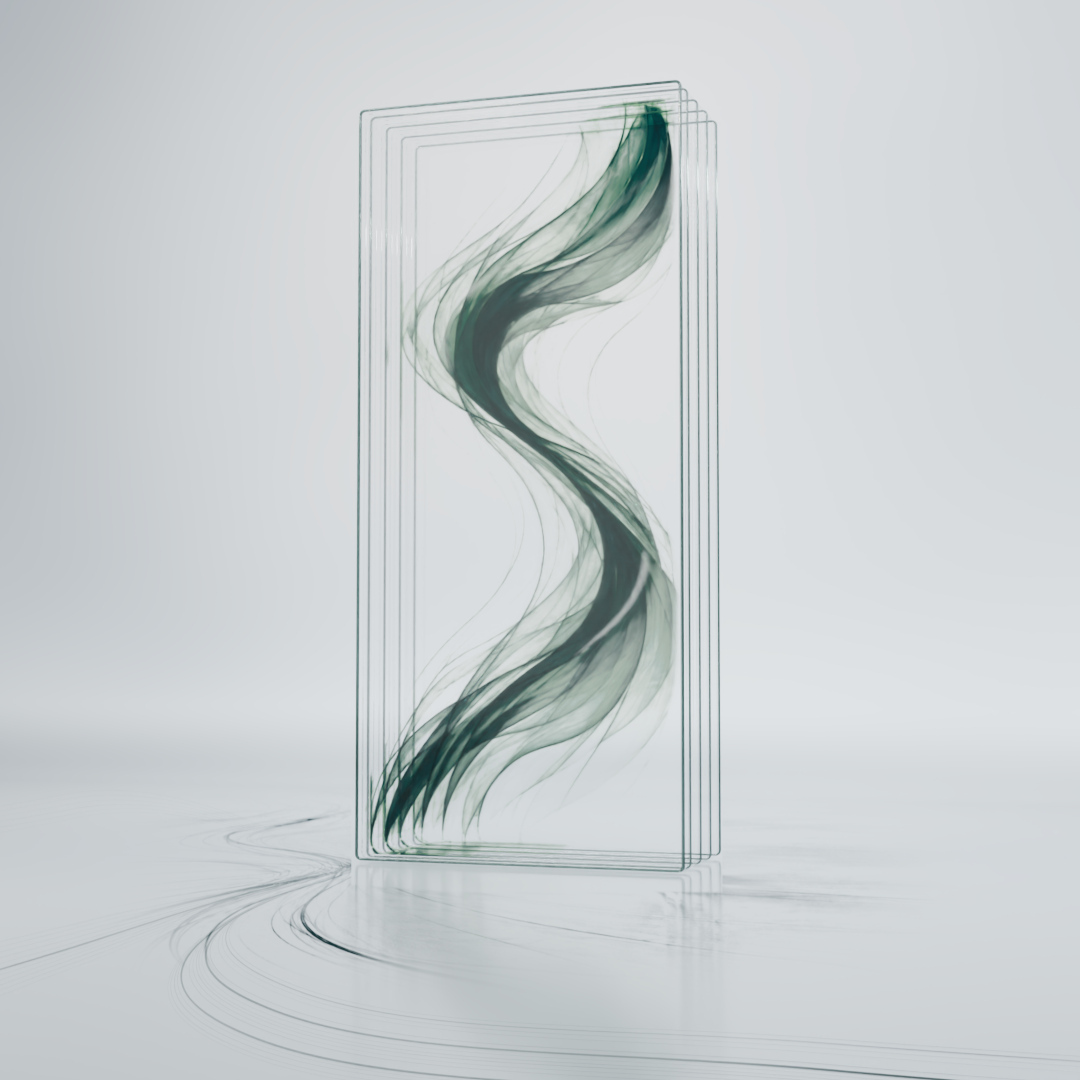
In “Alignment of Phases”, I explore how a whole emerges from separate fragments. Twelve glass plates move in relation to one another, allowing lines to meet, break apart and form a single flowing image. The image exists through the alignment of its layers.
CONCEPT AND STORY
“Alignment of Phases” is a digital sculpture inspired by bioinformatician Dmitry Penzar’s research into genetics and machine learning. I created the work for a joint project by Pravila Zhizni and the Sber Science Award.
Penzar’s team develops neural-network methods, including LegNet, to predict the activity of regulatory DNA sequences and search for sequences with specified characteristics. How can one find a combination with a desired property among countless possibilities? This question became the starting point for the work.
Penzar’s team develops neural-network methods, including LegNet, to predict the activity of regulatory DNA sequences and search for sequences with specified characteristics. How can one find a combination with a desired property among countless possibilities? This question became the starting point for the work.
ARTISTIC INTENT
I wanted to focus on the process of searching: the result depends on how individual elements are arranged and connected. Each plate carries only part of the image. It is the relationship between the layers that allows a complete form to appear.
The moment of alignment became a metaphor for discovery. Among many possible states, a configuration emerges in which a new property becomes visible. Even a small change in the relationships between elements can change the result.
The moment of alignment became a metaphor for discovery. Among many possible states, a configuration emerges in which a new property becomes visible. Even a small change in the relationships between elements can change the result.
MOVEMENT AND PERCEPTION
Twelve transparent glass plates move and turn. Lines intersect, briefly align and drift apart again. The composition passes through moments of apparent order before the fragments gradually form a continuous luminous relief.
The plates come to rest, but movement continues. Glowing pigment travels along the lines, and the graphic pattern extends beyond the sculpture into the surrounding space. The final alignment becomes a new state of movement.
The plates come to rest, but movement continues. Glowing pigment travels along the lines, and the graphic pattern extends beyond the sculpture into the surrounding space. The final alignment becomes a new state of movement.
VISUAL LANGUAGE
Transparency makes the relationship between the layers visible. The edges of the glass remain distinct, while the fine lines overlap and gather into a flowing form. Seen at an angle, the image separates into its individual planes.
The restrained green palette and pale environment keep attention on the drawing, its density and the spaces between the plates. Where the lines continue onto the floor, the image begins to connect the sculpture with its surroundings.
The restrained green palette and pale environment keep attention on the drawing, its density and the spaces between the plates. Where the lines continue onto the floor, the image begins to connect the sculpture with its surroundings.
PROCESS AND TECHNOLOGY
The work was developed in Blender and rendered in Cycles. I worked with twelve separate layers so that the image could emerge through their relative positions. The animation moves from a search among fragments to alignment, then to the passage of pigment through the completed form.
The accompanying stills show the finished composition, an intermediate state and a full view of the aligned sculpture. The Blender view reveals how the drawing is distributed between the twelve plates.
The accompanying stills show the finished composition, an intermediate state and a full view of the aligned sculpture. The Blender view reveals how the drawing is distributed between the twelve plates.